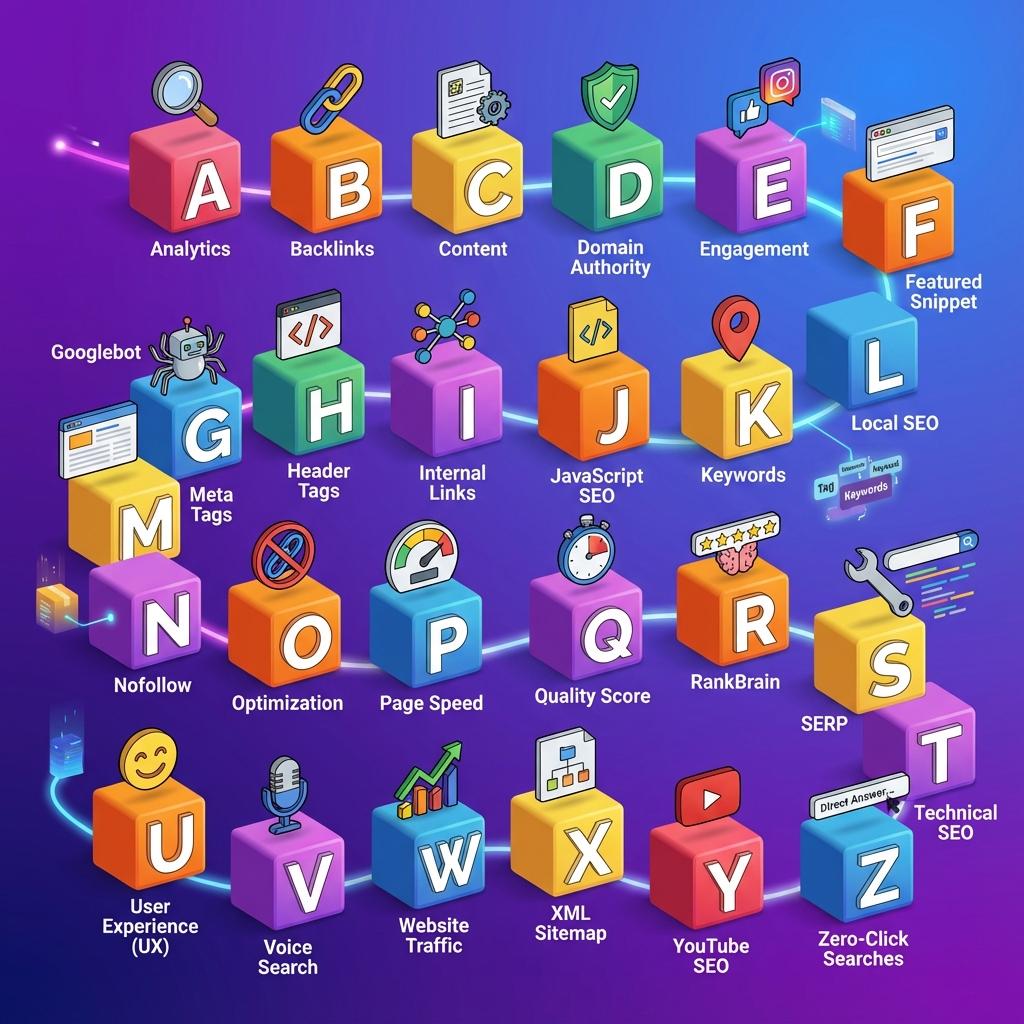
Master SEO concepts one letter at a time. This comprehensive glossary covers every important SEO term and concept from A to Z, giving you the knowledge foundation you need to succeed in search engine optimization.
A – Analytics
Analytics is the backbone of smart decision-making in SEO and marketing. It transforms raw data into meaningful insights, helping you understand user behavior, track performance, and measure ROI. With analytics, every click, bounce, and conversion tells a story. The more you measure, the sharper your strategies become.
B – Backlinks
Backlinks act as votes of trust from other websites. High-quality backlinks boost your site's authority, credibility, and rankings. However, not all links are equal — focus on relevant, high-authority sources rather than spammy links.
C – Conversions
Conversions are the ultimate goal of digital strategy—turning visitors into loyal customers. Whether it's a click, sign-up, or purchase, every conversion proves your message connects. SEO brings people in, but conversion ensures impact.
D – Domain Authority
Domain Authority is like your website's reputation score in the digital world. Higher authority means search engines trust you more, giving your content better visibility. It grows through quality backlinks, consistent content, and user trust.
E – Engagement
Engagement measures how users interact with your content — time on page, comments, shares, clicks, and conversions. Search engines value engaging content because it shows relevance and usefulness.
F – Featured Snippets
Featured snippets are the answer boxes that appear on top of Google results. Optimizing for them means answering common questions concisely, structuring content well, and using schema markup.
G – Geo-Targeting
Geo-targeting means optimizing content for specific locations and regions. From local keywords to Google Business Profile optimization, it ensures your business is found by the right audience at the right place.
H – Headings (H1, H2, H3…)
Headings structure your content for readers and search engines. Proper use of headings improves readability, SEO optimization, and content flow.
I – Indexing
Indexing is the process by which Google adds your site's content into its database. If your site isn't indexed, it won't appear in search results. Tools like Search Console help monitor indexing issues.
J – JavaScript SEO
JavaScript SEO ensures that content powered by scripts is still crawlable and indexable by search engines. Many modern websites depend on JS for navigation and content loading — if Google can't render it, rankings suffer.
K – Keywords
Keywords are the foundation of SEO. From short-tail (broad) to long-tail (specific) phrases, choosing the right keywords ensures your content matches search intent.
L – Link Building
Link building is the process of acquiring quality backlinks. Strategies include guest posting, digital PR, HARO, and creating share-worthy content.
M – Meta Tags
Meta tags (title, description, alt text) help search engines understand your content. A well-crafted meta title and description also improve CTR (Click-Through Rate).
N – Niche Targeting
Every successful SEO strategy focuses on a specific niche. Narrowing down helps you dominate a smaller market and stand out as an expert.
O – Optimization
Optimization is the art of constant improvement. In SEO, it's refining pages, content, and speed. Winners don't wait for perfection; they keep optimizing step by step until good becomes great.
P – Page Speed
Page speed is a critical ranking factor. Slow sites drive users away. Compress images, use caching, and optimize hosting for faster load times.
Q – Quality Content
Google prioritizes quality over quantity. Content should be original, valuable, and helpful. Remember Google's E-E-A-T principles: Experience, Expertise, Authoritativeness, and Trustworthiness.
R – Rankings
Rankings reflect where your website appears in search results. Tracking your rankings helps measure progress, though the real focus should be on traffic and conversions.
S – Schema Markup
Schema is structured data that helps search engines understand your content. It enables rich snippets like ratings, FAQs, and events.
T – Technical SEO
Technical SEO ensures your site is crawlable, secure, and fast. Key areas include XML sitemaps, robots.txt, HTTPS, canonical tags, and mobile-friendliness.
U – User Experience (UX)
User experience impacts SEO directly. A site that's easy to navigate, mobile-friendly, and visually appealing encourages visitors to stay longer and engage more.
V – Voice Search
With smart devices rising, voice search is transforming SEO. Target conversational keywords and FAQs to optimize for this trend.
W – Website Authority
Authority signals include backlinks, brand mentions, and high-quality content. The stronger your authority, the higher your chances of ranking for competitive keywords.
X – XML Sitemap
An XML sitemap guides search engines through your site's structure. Submitting it to Google Search Console improves crawlability and indexing.
Y – Yield
In SEO, yield is the ROI — rankings, leads, and growth from your efforts. Nothing comes instantly, but with persistence, the harvest always arrives.
Z – Zero-Click Searches
Zero-click searches happen when Google answers a query directly on the SERP — via snippets, knowledge panels, or local packs. While clicks may decrease, visibility and authority increase.
Ready to Apply These SEO Concepts?
Let me help you implement effective SEO strategies for your business.
Get Started Today