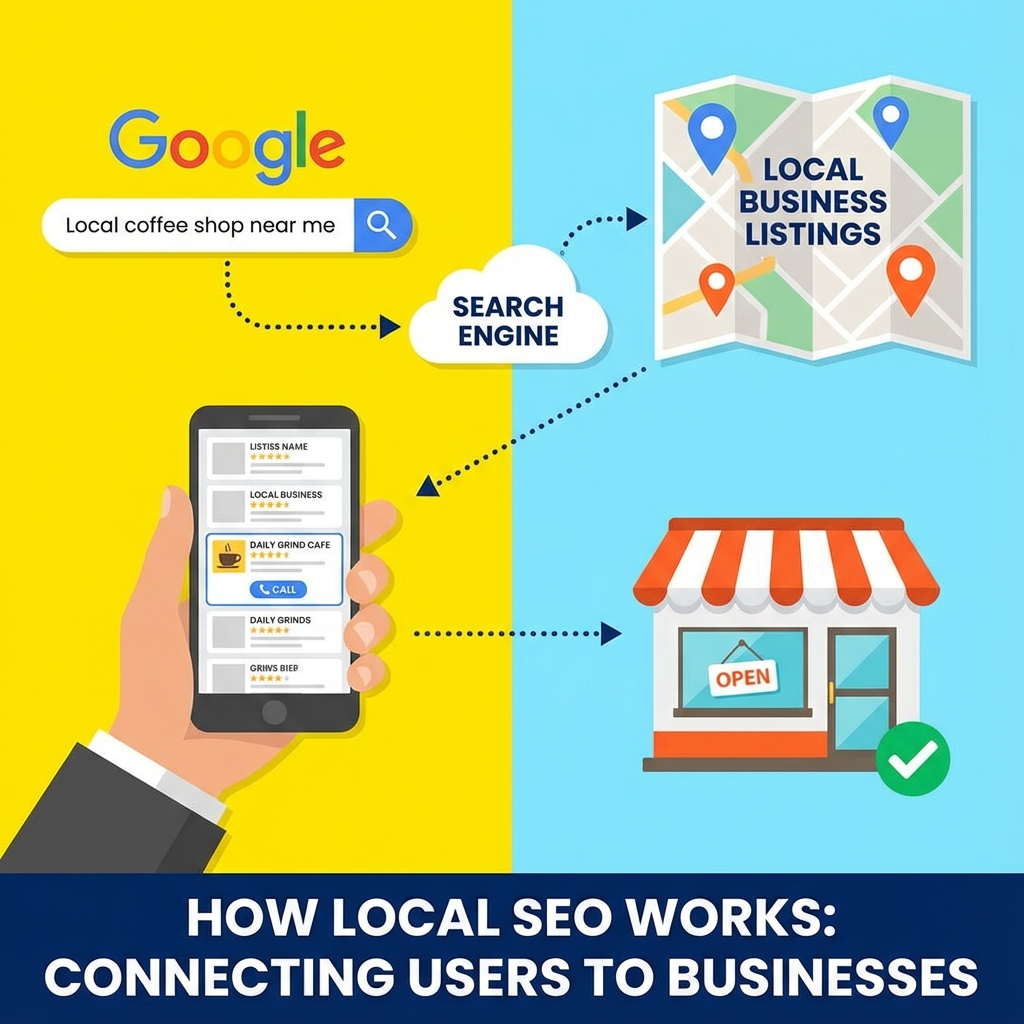
What Is Local SEO?
Local SEO (Search Engine Optimization) is the process of optimizing your online presence to attract more customers from local searches on Google and other search engines. When someone types "coffee shop near me" or "best plumber in [city name]," Google shows results based on location, relevance, and reputation.
Unlike regular SEO, which targets global visibility, local SEO focuses on improving your ranking in specific geographic areas. It helps your business appear on Google Maps and the "Local 3-Pack" — those top three local results that pop up before organic listings.
The Purpose of Local SEO
The goal of local SEO is simple — to make your business easily discoverable by nearby customers looking for your services. Whether you run a restaurant, a salon, or a law firm, local SEO ensures people find you at the exact moment they need you.
It bridges the gap between online searches and real-world sales. Studies show that over 76% of people who search for something nearby visit a store within a day, and 28% of those searches result in a purchase.
How Search Engines Use Location Data
When users perform local searches, Google uses several data points — GPS signals, IP address, search history, and even Wi-Fi networks — to determine their location.
Then, it matches that location with relevant businesses nearby. For example, if someone searches "pizza delivery," Google doesn't just show global pizza chains; it shows the closest, best-rated options in that area.
Why Local SEO Is Important in 2025
The way people search has changed dramatically. Today, more than 60% of Google searches are local, and voice searches like "find a dentist near me" are growing every year.
In 2025, with AI-driven search algorithms, local intent has become even stronger. Google's updates now prioritize authentic local relevance — meaning that businesses with accurate listings, real reviews, and active local engagement get rewarded.
Mobile Searches and "Near Me" Trends
Thanks to smartphones, users now expect instant local results. Google Trends shows exponential growth in "near me" searches like "gas station near me" or "best coffee nearby."
If your business isn't optimized for mobile and local SEO, you're missing out on massive potential customers who are literally around the corner.
Local SEO for Small Businesses and Startups
Local SEO is a game-changer for small businesses. You don't need a huge advertising budget to compete with large corporations. With optimized listings, strong reviews, and quality local backlinks, even a small café can outrank national chains in local searches.
How Local SEO Works Step-by-Step
Let's break down how local SEO works in practical terms:
Step 1: Optimize Your Google Business Profile (GBP)
Your Google Business Profile (formerly Google My Business) is your local SEO foundation. Make sure to:
- Fill out your profile completely (name, address, phone, hours, website)
- Add high-quality photos
- Choose accurate categories
- Post updates regularly
- Encourage customer reviews
This listing helps your business appear in Google Maps and the "Local Pack."
Step 2: Build Local Citations
Citations are online mentions of your business's Name, Address, and Phone number (NAP). Ensure your NAP is consistent across platforms like:
- Yelp
- Bing Places
- Apple Maps
- Local directories and business listings
Inconsistent information can confuse search engines and lower your rankings.
Step 3: Gather Customer Reviews
Google heavily values genuine customer feedback. Positive reviews not only build trust but also boost your visibility.
💡 Tip: Respond to every review—good or bad. It shows engagement and improves credibility.
Step 4: Optimize Your Website for Local Keywords
Your website should include geo-targeted keywords like "plumber in Dallas" or "SEO agency in London." Use these in:
- Meta titles and descriptions
- Headings and subheadings
- Service pages
- Blog posts
Step 5: Create Local Content That Converts
Write content that resonates with your local audience:
- Feature local events or news
- Collaborate with nearby businesses
- Create guides like "Top 5 Places to Eat in [City]"
This helps you connect with your community and attract organic local traffic.
Step 6: Build Local Backlinks
Local backlinks (from neighborhood blogs, chambers of commerce, or local media) signal trustworthiness. The more reputable local sites linking to you, the higher your site ranks.
Key Ranking Factors for Local SEO
Google uses three major ranking signals for local SEO:
- Proximity: How close your business is to the searcher.
- Relevance: How well your business matches the search query.
- Prominence: How well-known and trusted your business is online.
Local SEO Tools You Should Use
Here are some must-have tools to simplify your local SEO efforts:
- Google Business Profile Manager
- BrightLocal
- Moz Local
- Whitespark
- Google Analytics & Search Console
Common Local SEO Mistakes to Avoid
Avoid these pitfalls:
- Inconsistent NAP info
- Ignoring negative reviews
- Keyword stuffing city names
- Not optimizing for mobile users
These errors can hurt your credibility and push your rankings down.
How to Measure Local SEO Success
Track your local SEO progress by monitoring:
- Rankings in the local pack
- Website traffic from local searches
- Click-to-call and direction requests
- Review growth and engagement
Use Google Analytics and GBP Insights to measure conversions and visibility.
Advanced Local SEO Strategies for 2025
- Voice Search Optimization: People ask conversational queries like "Where's the nearest gym?"
- AI and Personalization: Google tailors results based on past behavior.
- Hyperlocal SEO: Target smaller neighborhoods for more precise results.
FAQs About Local SEO
How long does it take for local SEO to work?
Usually 3–6 months, depending on competition and consistency.
Do I need a website for local SEO?
Yes, but even without one, a well-optimized Google Business Profile can still help.
How much does local SEO cost?
It can range from free (DIY) to $500–$2000/month with agencies.
What's the difference between local SEO and Google Ads?
Local SEO brings free, organic traffic; Google Ads are paid placements.
Can local SEO help service-based businesses?
Absolutely! It's ideal for plumbers, electricians, consultants, and more.
Conclusion
Local SEO is one of the most effective ways to connect with your nearby audience and grow your business organically. By optimizing your listings, creating local content, and engaging with customers, you can dominate local search results — even against bigger brands.
Need Help with Local SEO?
Let me help you dominate your local market with proven SEO strategies.
Get Started Today